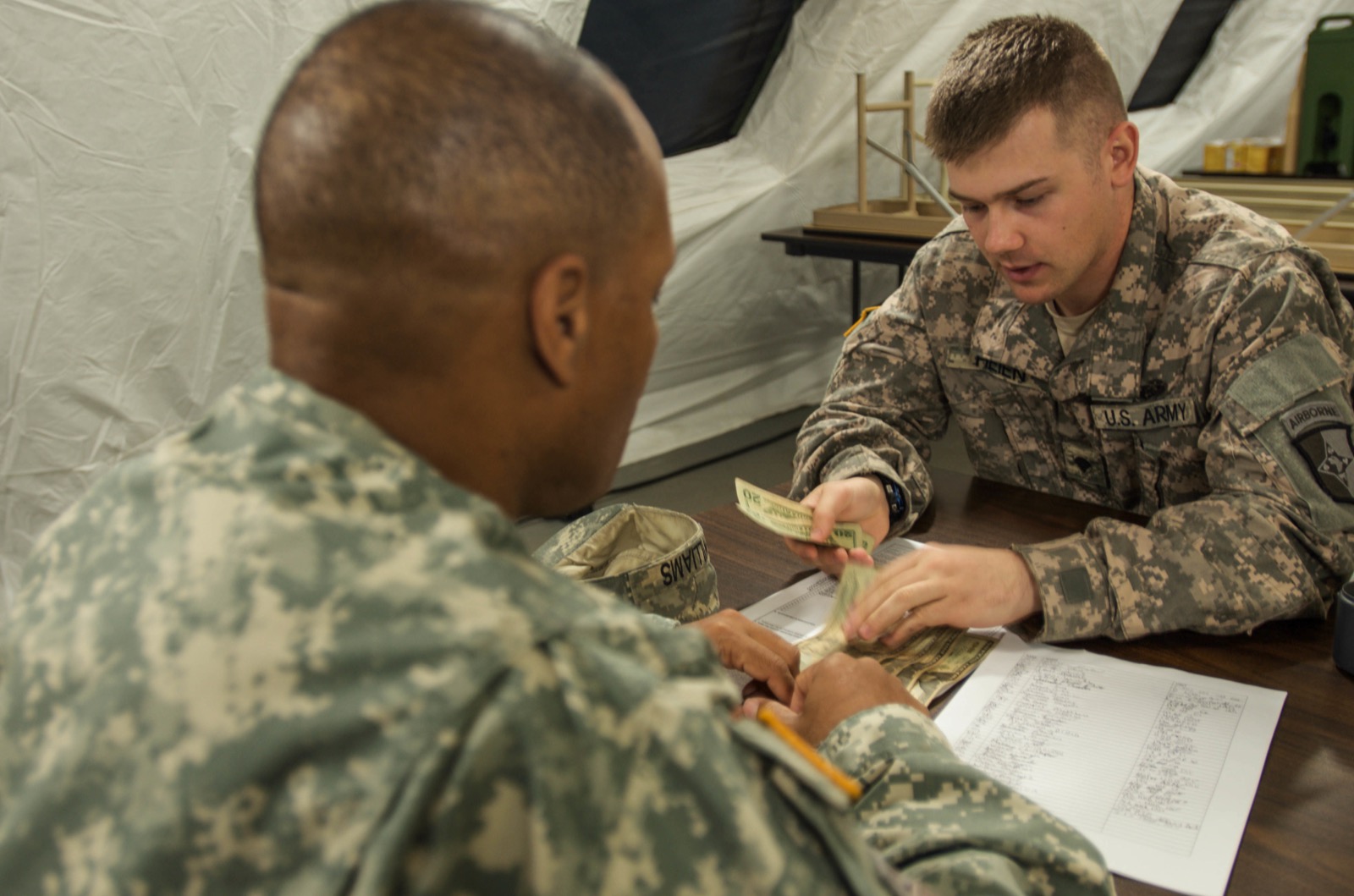
When two service members marry with no kids, you each keep drawing your own BAH at the without-dependents rate for your own pay grade and duty station. Neither of you can claim the other, because federal law says a spouse who’s on active duty and drawing basic pay isn’t a dependent. Add a child and one of you takes the with-dependents rate. Two separate payments usually beat one with-dependents check. Amounts vary by ZIP, so check the DoD calculator.
If you’re both in uniform, the “get married, get the with-dependents rate” advice you’ll read everywhere doesn’t apply to you. Dual-military couples, sometimes called mil-to-mil or dual-mil, run on their own set of rules, and those rules are written down in one place we’ll cite below. The good news is that most couples come out ahead anyway.
Do Dual-Military Couples Both Get BAH?
Yes. The military doesn’t take one allowance away because you married another service member. Each of you draws BAH based on your own pay grade and your own duty station, and that continues after the wedding.
What you don’t get is the with-dependents bump. BAH has two dependency categories, without dependents and with dependents, and the higher one requires an actual dependent. Here’s the specific reason two service members can’t claim each other, and it’s statutory rather than a policy anyone can waive: under 37 U.S.C. § 421, a dependent who is on active duty in a uniformed service and entitled to basic pay cannot be considered a dependent for housing allowance purposes. Your spouse is drawing basic pay, so your spouse isn’t a dependent. Same in reverse.
With no kids in the picture, you each stay at the without-dependents rate for your grade and ZIP. That’s true whether you’re living together or living apart, as long as neither of you is in government quarters.
That can feel like a raw deal until you do the arithmetic.
Does Mil-to-Mil Get Double BAH?
Not doubled, exactly, but two payments instead of one, and that’s usually the better outcome.
A single-military couple gets one BAH payment at the with-dependents rate. A dual-military couple gets two payments at the without-dependents rate. Two checks, even at the lower category, typically add up to more total housing money than one check at the higher category. Neither payment is increased by the marriage, so don’t expect a jump on your next LES. What you should expect is that your combined household housing money is larger than a comparable single-military household’s.
The exact comparison depends on both of your pay grades and both of your ZIP codes, so run your real numbers rather than trusting a rule of thumb.
Dual-Military BAH Calculator: Run Both of Your Numbers
Run this twice, once for each of you, using each member’s own pay grade and duty station. Add the two without-dependents figures together and that’s your household total. The with-dependents column is what you’d draw only if one of you later claims a child.
Your BAH Calculation Results
Figures come from the DoD 2026 Basic Allowance for Housing tables, effective January 1, 2026 (rates verified July 2026). BAH is recalculated every January. For the authoritative figure tied to your duty-station ZIP, use the official DoD BAH rate lookup, and confirm entitlement questions with your finance office.
That increase starts on your wedding day, not before it.
BAH back-pays to the date you're married, so every month you wait is a month at the lower rate. We marry military couples over Zoom from wherever you're stationed, and the certified Utah certificate (the document DEERS asks for) usually lands within about 24 hours. The ceremony is $349 plus Utah's $71 license fee.
Rates come from the DoD 2026 BAH tables, effective January 1, 2026, and we last checked them against the official lookup in July 2026. BAH resets every January and can differ by hundreds of dollars between neighboring ZIP codes, so treat any figure with a date on it as perishable.
Who Gets BAH With Dependents When You Have a Kid?
A child is a dependent. That’s the moment the with-dependents rate enters the picture for a dual-military couple.
The rule here gets stated wrong all over the internet, usually as “the higher-ranking member automatically claims the child.” That isn’t what the regulation says. When two married service members have a dependent child together and aren’t assigned government quarters, they choose which one receives BAH at the with-dependents rate. Only if the two of you can’t agree does the senior member receive it by default. You can also transfer the election from one member to the other later on, though changes take effect from the election date and don’t get applied retroactively.
That distinction is worth money. Because you pick, you should pick the member whose with-dependents rate is worth more, which is often the one stationed in the more expensive housing market rather than the one with the higher rank. Run both before you file.
Only one of you can claim the same dependent, so there’s no double-dipping. The same one-claim rule applies to stepchildren and kids from a prior relationship: one member claims the children collectively, and the other stays at the without-dependents rate.
Dual-Military BAH by Scenario
| Your situation | Member A | Member B |
|---|---|---|
| Married, no kids, same base | Without-dependents rate for A’s grade and ZIP | Without-dependents rate for B’s grade and ZIP |
| Married, no kids, stationed apart | Own without-dependents rate at A’s station | Own without-dependents rate at B’s station |
| Married with one child, together | With-dependents rate (whichever member you elect) | Without-dependents rate |
| Married, jointly in on-base family quarters | No BAH | No BAH |
| Separated by orders, a child living with each | With-dependents rate | With-dependents rate |
That last row is the exception most couples never hear about, and it’s covered below.
Do Dual-Military Couples Get BAH in On-Post Housing?
This is where dual-mil couples get caught out, because the answer is different from what a single-military family experiences.
When service members married to each other jointly occupy family-type government quarters, neither member is authorized BAH or OHA, even if no dependent lives in the quarters. Not one allowance between you. Neither. The exception is narrow: if a dependent is prevented by military order from occupying the quarters, that changes the analysis.
Compare that to a single-military family, where the member technically still has a BAH entitlement that gets routed to the privatized housing company. For a dual-mil couple in family quarters, there’s nothing to route.
So the on-post decision is worth modeling properly. Two without-dependents allowances that you keep, minus rent and utilities off base, versus free family quarters and zero allowance. In a cheap housing market the quarters often win. In an expensive one, where both of your allowances are large, going off base and pocketing the difference frequently wins by a wide margin. Run both of your numbers through the DoD BAH lookup before you accept a housing offer.
Single government quarters are a separate question. Each member is authorized BAH at the appropriate rate when family-type quarters aren’t assigned, even if adequate single quarters happen to be available, unless your commander specifically requires you to live in single quarters.
How Does Dual-Military BAH Work If You’re Not Stationed Together?
Plenty of dual-military couples spend their first married stretch at different bases, sometimes in different states or countries. BAH handles this cleanly, since each allowance is tied to its own duty station. Nobody loses money for living apart, and a member at a high-cost duty station draws the high-cost rate regardless of where the other one is.
There’s a real wrinkle worth knowing if you have kids. Normally only one of you can draw the with-dependents rate. But when orders separate you so that you no longer share a common residence, each member’s entitlement gets determined separately, and each member may draw BAH at the with-dependents rate if a dependent child actually lives with that member. Two with-dependents allowances at once, in other words, in the specific case where the kids are split between two households created by military orders. If that’s your situation, take the regulation paragraph to your finance office rather than relying on a counter clerk’s memory.
Getting your marriage into DEERS does two more things here. It makes you eligible for your branch’s join spouse assignment program, which tries to station married service members within commuting distance of each other. It’s a request rather than a guarantee, and it works best when the marriage is on record early enough for your detailer or assignment manager to factor it into your next set of orders. If either of you will be taking a new name, our sister site, Change Your Name, walks through the name-change paperwork after the wedding, one office at a time.
It also opens the door to Family Separation Allowance if one of you deploys or goes on unaccompanied orders away from the other for more than 30 days. None of that starts until the marriage is in DEERS.
What Regulation Covers Dual-Military BAH?
If you need to point your finance office at chapter and verse, or you’re trying to settle an argument in the barracks, here’s the citation.
The governing rule is the DoD Financial Management Regulation (DoD 7000.14-R), Volume 7A, Chapter 26, paragraph 4.5, titled “Service Member Married to Another Service Member.” The subparagraphs cover the situations above: 4.5.2.1 for no dependents, 4.5.2.2 for jointly occupied family-type quarters, and 4.5.2.3 for the with-dependents election when you have children. For when the money actually starts after you leave the barracks, the start rule is paragraph 8.1.5 in the same chapter: the allowance accrues from the date the government-quarters assignment is terminated. The chapter is published by the DoD Comptroller, and the version current as of July 2026 carries a May 2025 revision date.
The underlying statute is 37 U.S.C. § 421, the provision saying a dependent on active duty and entitled to basic pay can’t be treated as a dependent for housing allowance purposes.
Each branch layers its own procedural guidance on top of the FMR, which is why an Army answer and a Navy answer can sound different while resting on the same rule. The FMR is the tiebreaker. Your finance office is still the place to confirm how it applies to your record, especially around effective dates.
Getting Out of the Barracks When You’re Both Junior Enlisted
Here’s a scenario that trips up young dual-mil couples. You’re both E-3 or E-4, both living in the barracks, and neither of you is drawing a BAH deposit because single junior enlisted usually can’t. You get married and assume the housing money appears. It doesn’t happen automatically.
Marriage is what makes you eligible to move off base, but you still have to go through your command to out-process from the barracks and get your BAH started. Each of you handles your own paperwork, since you’re each your own sponsor. Once that clears, you’re both drawing your own without-dependents BAH and can pool it toward a place off base together. For a lot of couples that combined amount goes a lot further than two barracks rooms, which is the practical win of getting married even before any kids enter the picture.
And to head off the question finance offices hear constantly: there’s no back pay to your wedding date in this scenario. That rule belongs to the member-marries-civilian case, where the with-dependents entitlement legally starts on the date of marriage. In a mil-to-mil marriage with no kids, neither of your entitlements changed — what changes is your quarters assignment. Under FMR Volume 7A, Chapter 26, paragraph 8.1.5, a housing allowance accrues from the date your assignment to government quarters is terminated, or the date you vacate if the move-out was approved. Moving out on your own without the command’s sign-off starts nothing, either: paragraph 8.1.2 says you’re still considered assigned to quarters. So the clock starts the day your barracks assignment ends, not the day you say “I do.”
Marrying Sooner Starts the Clock
For dual-military couples, the payoff of marrying isn’t a bigger BAH check. It’s eligibility. Join spouse consideration, Family Separation Allowance, joint travel entitlements, and permission to move out of the barracks together all wait on a marriage being on record in DEERS.
The problem is that two military schedules rarely line up. You’re both fighting leave calendars and PCS timelines at once, and the window where you’re both free in the same place can sit a year out. That’s why a lot of dual-mil couples get legally married first and plan the celebration later. An online military wedding lets you hold a legal ceremony over video under Utah law from wherever each of you happens to be stationed, as long as you can both hold a video call for about twenty minutes. Certified certificate in about a day, DEERS the same week, join spouse request in the works before your next assignment cycle. The ceremony fee is $349 plus Utah’s $71 license, a small number against months of separation you might otherwise spend waiting to even be eligible for a join spouse move.
One thing worth being clear about: if one of you genuinely can’t get online, a video ceremony isn’t an option, and you’d be looking at proxy marriage instead. We don’t offer that. That page explains honestly where the line falls.
Related Reading
If only one of you serves, the rules are different and simpler: see BAH married vs single. For the step-by-step from ceremony to updated LES, DEERS enrollment included, use the full BAH after marriage guide. And as with every number here, rates reset each January and vary by ZIP code, so verify your exact figures with the DoD BAH lookup and entitlement questions with your finance office.
The Bottom Line
Two service members who marry each keep their own BAH at the without-dependents rate, because a spouse drawing basic pay isn’t a dependent under 37 U.S.C. § 421. Two payments usually total more than one with-dependents check. Kids change that: you elect which one of you claims the child for the higher rate, with the senior member as the tiebreaker if you can’t agree. Jointly occupying on-base family quarters means neither of you draws BAH at all. Stationed apart, you each draw for your own ZIP, and registering the marriage opens up join spouse and Family Separation Allowance.
If only one of you is in uniform, the math runs differently. See how BAH changes from single to with-dependents for that case, and our complete guide to military BAH after marriage for the full DEERS and finance walkthrough.